Diving Deeper into the Enneagram Typology
If you’re new to the Enneagram—or you’ve heard people throw around numbers and wings and arrows—it can feel both intriguing and confusing. This post is meant to give you a clear, steady foundation for understanding what the Enneagram actually is, how it works, and why so many people find it meaningful for personal growth, relationships, and healing.
This isn’t about typing yourself yet. It’s about learning the language of the system so you can use it well.
What is the Enneagram?
The Enneagram is a personality system rooted in ancient spiritual traditions that describes people in terms of core motivations, desires, and fears—not just observable behavior.
The word Enneagram comes from the Greek:
ennea (nine)
gramma (something drawn or written)
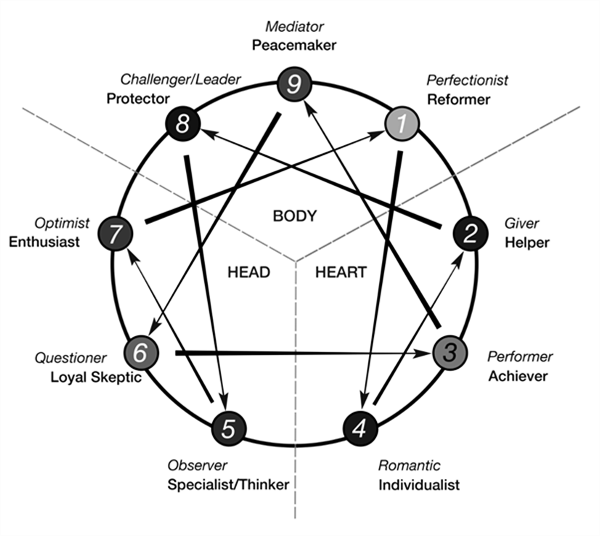
The Enneagram maps nine distinct personality types on a nine-pointed diagram. That diagram matters—not because it’s mystical, but because it visually represents how the types relate to one another, especially under stress and in growth.
Today, the Enneagram is widely used in counseling, leadership development, spiritual formation, and relational work because it helps people understand why they do what they do—not just what they do.
At its best, the Enneagram doesn’t put you in a box. It helps you see the box you learned to live in—and how to step out of it.
The Nine Types (At a Glance)
Each Enneagram type reflects a core belief about how the world works and what a person needs to do to belong, be safe, or be okay.
Here’s a brief overview—not to identify yourself yet, but to understand the landscape:
One – The Perfectionist
Motivated by integrity and rightness; fears being flawed or corrupt.Two – The Helper
Motivated by connection and love; fears being unlovable or unwanted.Three – The Achiever
Motivated by value and success; fears being seen as failing or worthless.Four – The Individualist
Motivated by authenticity and depth; fears being fundamentally flawed or missing something essential.Five – The Investigator
Motivated by understanding and autonomy; fears being overwhelmed or depleted.Six – The Loyalist
Motivated by safety and security; fears being unprepared or unsupported.Seven – The Enthusiast
Motivated by freedom and possibility; fears being trapped in pain or deprivation.Eight – The Challenger
Motivated by strength and protection; fears being controlled or harmed.Nine – The Peacemaker
Motivated by harmony and connection; fears conflict or loss of relationship.
Each type makes sense once you understand the fear beneath it. No type is “better” or more evolved than another.
Three Centers of Intelligence
A foundational part of the Enneagram is understanding the three centers of intelligence, also called triads (heart, head, body). Each type relies most heavily on one primary way of processing the world.
HEART TYPES — 2, 3, 4
Heart types navigate life through emotion and relational awareness. They’re attuned to connection, belonging, and how they’re perceived by others.
HEAD TYPES — 5, 6, 7
Head types rely on thinking, planning, and anticipating. They focus on safety, certainty, and making sense of the future.
BODY TYPES — 8, 9, 1
Body types process through instinct and action. They’re guided by gut reactions, boundaries, and a sense of rightness or justice.
Understanding triads often explains why people can experience the same situation so differently—and why communication can break down when we assume everyone processes the world the way we do.
Wings: Personality Range
Each Enneagram type has two neighboring types called wings. These represent related styles you may lean into at different times.
For example:
A Four’s wings are Three and Five
A Seven’s wings are Six and Eight
Some people identify strongly with one wing (like “4w3”). Others notice flexibility between both. Rather than locking you into a subtype, wings show how your personality has range and movement.
They’re best understood as adjacent resources—not definitions.
Arrows: Stress & Growth Patterns
The Enneagram diagram also includes arrows, which describe how each type tends to move under stress and in growth.
Rather than labeling these movements as “good” or “bad,” arrows show:
Patterns we may fall into when we’re overwhelmed
Capacities we grow into as we become more secure and whole
Arrows remind us that personality is not static. We’re dynamic, shaped by context, safety, and development over time.
A Grounded Way to Begin
The Enneagram isn’t about self-improvement through fixing yourself. It’s about self-understanding that leads to compassion—for yourself and for others.
If you’re just beginning, start here:
Learn the system
Notice patterns without rushing to label
Stay curious, not critical
The Enneagram is most helpful when it’s used slowly, relationally, and with humility.
From here, you can explore:
Which Enneagram Type Are You?
Deep dives into each type
How attachment, relationships, and healing intersect with the Enneagram
This post is the map. The journey unfolds from there.